Most leaders aren’t short on data. What they struggle with is trusting it. If you’ve ever opened a report and hesitated before acting because the numbers didn’t feel quite right, you’re not alone. Many teams spend hours pulling information from different tools, checking formulas, and reconciling inconsistencies just to feel confident enough to make a decision.
That hesitation is worth paying attention to. It usually isn’t a reflection of your team’s capability but a sign that the systems behind the data aren’t working together as they should.
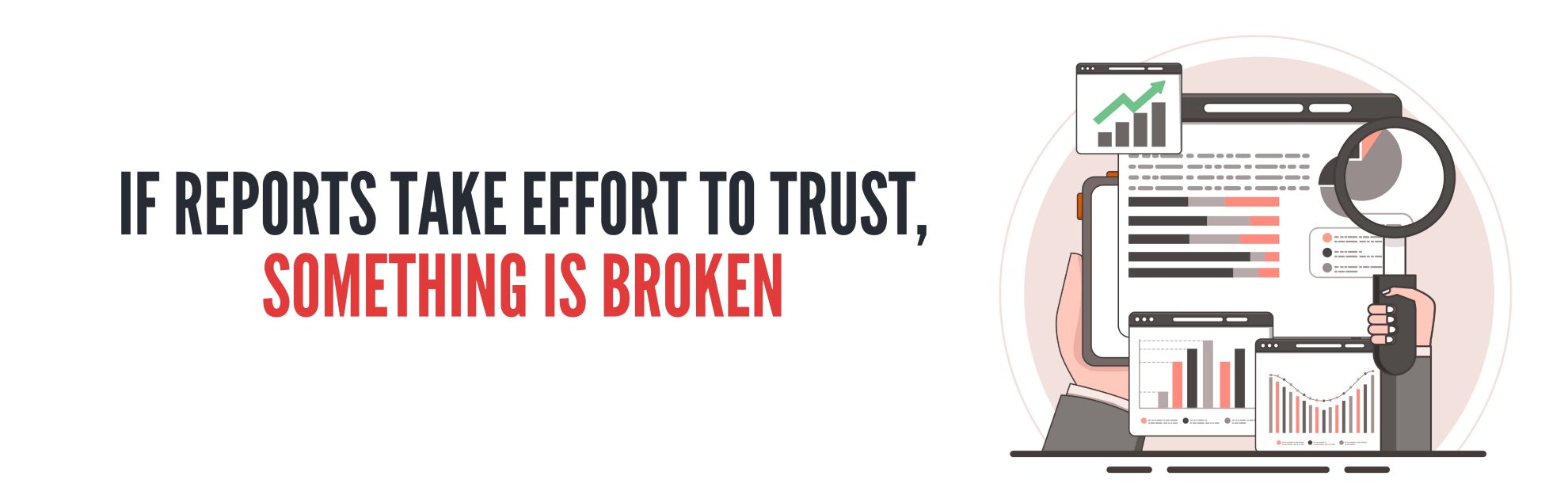
When reporting becomes a task, not a tool
In well-designed systems, reports help teams get answers quickly and move forward with confidence. When systems are fragmented, reporting starts to create more questions than clarity.
As businesses grow, data naturally spreads across CRMs, accounting platforms, project tools, and spreadsheets. Each system may be accurate in isolation, but without a shared structure, numbers begin to drift. Teams end up manually pulling information together, often under pressure and with limited context.
The outcome is a report that arrives late, feels fragile, and needs to be explained every time it is shared. Instead of supporting decisions, reports become something teams have to defend.
Trust should not depend on reconciliation.
When teams have to validate reports before using them, decision-making slows down. Meetings turn into debates about whose numbers are correct instead of discussions about what to do next.
This creates a quiet cost. Opportunities pass while data is being confirmed. Leaders delay decisions because confidence is missing. Over time, people rely more on instinct than insight, even though the data technically exists. The problem is not the report. It is the lack of a reliable system behind it.
Good dashboards are built on good foundations.
Dashboards are only as useful as the data feeding them. Without clear data sources, consistent definitions, and proper integrations, even the best-looking dashboards fail.
Reliable reporting requires systems that are designed to work together. Data needs a single source of truth. Updates should flow automatically. Reports should reflect reality as it happens, not hours or days later.
When this foundation is in place, reports stop feeling like something you need to verify and start feeling like something you can act on.
What changes when reports are trustworthy?
When teams genuinely trust their data, the way they work begins to change. Decisions happen faster because people aren’t stopping to validate numbers. Meetings shift away from explaining reports and toward discussing outcomes and next steps. Leaders spend less time second-guessing and more time acting with confidence.
Over time, reporting stops feeling like an operational chore and starts functioning as a strategic tool that supports clearer, more timely decisions.
Where Devfinity fits
Devfinity builds reporting systems and dashboards that connect data across tools, remove manual reconciliation, and deliver insights teams can rely on. The goal is simple: give leaders information they can trust the moment they see it.
If your reports require effort to believe, it may be time to rethink how your systems are designed.